Nitin Sethi
On the face of it, eco-development appears to have fared well in Kalakad Mundanthurai Tiger Reserve. But its effect on the forest remains largely unknown
Before the eco-development officer in Kalakad Mundanthurai Tiger Reserve (KMTR) sets off to meet the village forest committees (VFC, equivalent of the edc of the Indian Eco-development Project) in his Ambasamudram range, he has one important business to take care of. He has to ensure there are chairs for him, and for the visiting journalists, to sit on in the village we visit.
But it’s hard to find chairs in the largely agrarian valleys of Tirunelveli, Tamil Nadu; people like to sit on the ground. But forest department officers do not. The officer easily resolves the vexed problem. He picks up four brightly coloured chairs from his own range office and loads them on to his vehicle, along with a few staff members.
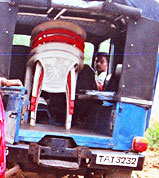 |
Chairs being carried for visiting journalists |
At each stop, the ritual is enacted. At the heart of the village, the visiting team alights from the vehicles. The chairs are placed at the eco-development community centre or at a convenient place.
Success stories
People gather. Members of the committees, excited kids and interested onlookers pretend
not to be part of the ‘event’ but hang around. The VFC members have stories to
tell. Stories of how money from the self-help groups or the committees has helped them
start a new business and increase their incomes. Idli makers, sweet makers, small
restaurants, even wood sellers. The options undertaken during the project varied, the way
it was supposed to.
The World Bank aided Forestry Research Education and Extension Project (FREEP) was initiated in 1994 for a five-year duration. Its purpose was simple; it was to test participatory biodiversity conservation in India. An additional sub-project titled Conservation of Biodiversity (CoB) was later formulated as part of the larger free Project.
Under the CoB, two Protected Areas, the Great Himalayan National Park in north India and the Kalakkad Mundanthurai Tiger Reserve in south India had been selected. The method of selection of these protected areas as experimental bases left much to be desired.
The northern one was chosen because the consultants were working there already and then the government wanted another one in the south for political correctness, remembers one consultant who had been party some of the parleys at that time.
The project was to help work with villages living at the periphery of the parks and those living insides. It envisaged that by providing the people livelihoods that were less impacting on the forests it could improve both, the economic situation of the villagers as well as forest health. In the case of KMTR the greatest challenge lay in one, reducing the 900 plus headloaders and two, reducing the number of cattle in the surrounding villages.
Problem areas
The study on revision of the management plan for the reserve, conducted in 2001, mentions
that there were around 13,600 cattle and 9,400 sheep and goat in the surrounding villages.
And most of these villages are nestled at the eastern end of the park, about 160 villages
in all. The project proponents, the state forest department, the consultants, the Union
government and the Bank in their wisdom believed that these two elements had the most
debilitating effect on the forests of the tiger reserve.
There was mention of the other 28 plus human habitations inside the forest too. Some, proliferating by government fiats, some built upon forestlands given away as lease in earlier years for various purposes. The impact of the creation of several dams in the heart of the park also got a mention. The park is home to rivers that remain the only source of water to an increasingly populated and an increasingly parched Tirunelveli district.
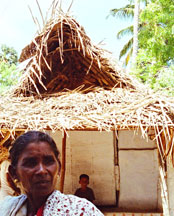 |
Settlements inside the forest are a threat, think officials |
What was prominently mentioned and often talked of were the 121 Kani tribal families living in five settlements in the reserve. The project officials believed fervently that the settlements had to be resettled outside the project site if the forest was to be saved from damage.
At the beginning
KMTR was fortunate. The project came to the region at a time when the officers posted
there were interested in implementing it, willing to experiment and break out of their own
moulds.
Venkatesh, a forest officer, was posted as the first eco-development officer at KMTR began work in right earnest. Even when the government was delaying the release of money, the department, under his guidance began field surveys.
"That sounds very complicated but all we did was visit each village we had to target. We just introduced ourselves to the villagers and tried to reduce the degree of antagonism that was always central to the forest department’s relation with surrounding villagers,’’ says the forest officer.
"In the process, we too learnt about the village dynamics. We realised that the village could not be looked upon as a single entity but as a political entity with its own factors of power play. We realised if this project had to work we would have to work around the existing power hierarchies and ensure that the money and benefits reached those who really needed it," he adds.
The village surveys also revealed that those dependent upon the forest most were those in the clutches of the local moneylenders. "Initially we never asked them to buy fixed assets from the money the project had to offer. We instead let them write off their loans. The local politicians also did not get involved as they would usually because the villagers took it upon themselves to decide where the money would be spent," says the current eco-development officer at KMTR.
The project divided the beneficiaries into three categories, those heavily dependent upon the forests (these were given a red card as identity), those less severely dependent (yellow card holders) and those who had the least dependency (green card holders). The department decided to target the red cardholders preferentially as they were the poorest in the village. Self help groups and village forest committees were formed with the help of more than 52 ngos that also participated in the formulation of a microplan for each committee.
On the success trail
The efforts at the beginning of the project paid off. Headloading reduced as the people
found alternative methods of earning a living. Perhaps not to the extent that the forest
department at times likes to pronounce, think many critics, yet considerably. Cattle
numbers got reduced. Most of the 182 village forest committees work successfully and 540
self help groups rotate money to their members at collection levels higher than any bank
operating in rural India can ever claim. They have created credit worth more than Rs 10
crore tripling the seed money of Rs 3 crore given to the villages under the project
(See: revealing stats)
Today
While the money business in the project has taken off wonderfully, its impacts on the
forest and its ecological measure remain uncertain. Venkatesh agrees that it was one
aspect that the project was weak in. "We should have studied the impacts of our
activities on the forest more carefully and scientifically, I agree."
The money now seems to be aggregating into activities that seem less and less to do with reducing pressure on the forests. As any profitable economic activity does, the business of self-help groups has its own logic – the money reaches those who can repay, not necessarily those who need it.
The forest department officers, egged on by annual reports that need to show annual recovery limits push the villager too to be careful whom to lend money to. The villages committees are prosperous enough to hire the services of the same people who used to work with the NGOs earlier, to help them with their increasingly elaborate accounting procedures.
In some villages, these are not the only self-help groups working but an entire gamut of such institutions exist. The project over, the forest department has little clue about the changing economic landscape in their vicinity or the desire to understand the next generation of the challenges that may come with improved economies, if any.
At the same time, the human habitations inside and their impacts on the forest remain uncontested by the department with the same ferocity with which it works at the marginalised Kani settlements, after all the other settlements are but part of the government’s own machinery – other departments of the state working on the dams or other activities. Can KMTR look beyond its project life? It’s a question that shouldn’t look for another project fund to get answers.

